
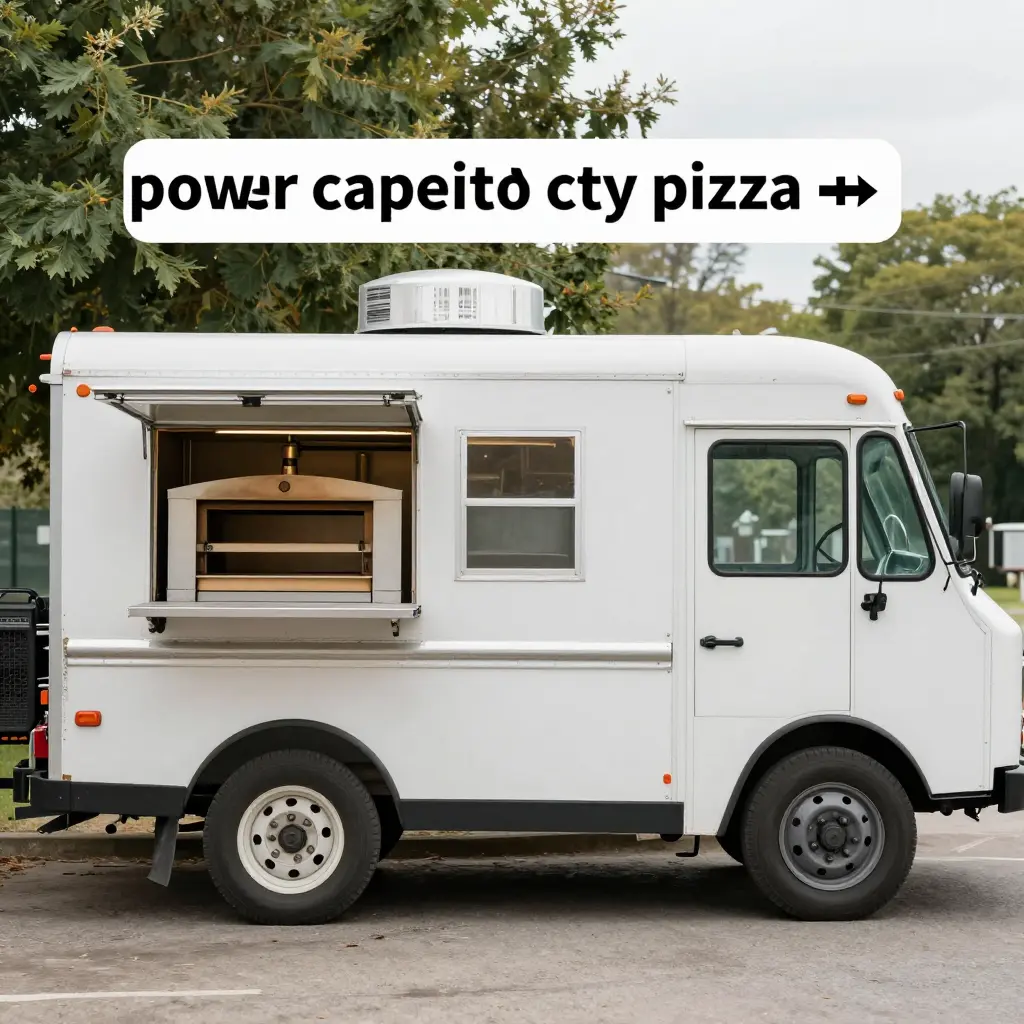
Why Your Pizza Truck Oven and Generator Must Match
Match your oven’s electrical demand to your generator and the truck works. Miss it and no amount of good dough or clean branding saves the night. The relationship between pizza truck oven power draw and generator capacity decides whether service runs smoothly or stalls.
An undersized generator trips breakers mid-service and ruins bakes. You end up apologizing to a line of customers while the dough sits cold, because the oven cannot pull the power it needs.
An oversized generator has its own costs. It burns more fuel than the job requires, adds weight to the build, and raises both the purchase price and the running costs. You pay for capacity you never use, and the extra weight comes out of the payload you could spend on refrigeration or prep equipment.
The fix is to size the generator so it covers the oven’s real draw plus a safe margin. That decision shapes the rest of the build, which is why it belongs near the front of any pizza food truck build.
This guide covers the main oven types and how each draws power, generator basics, the load math you need to run, practical sizing rules, and the questions operators ask most.
Pizza Oven Types and How Each Draws Power
Choosing an oven is really choosing an electrical profile. Before you match anything to a generator, know which oven you are powering and how it behaves under load. For the broader build, see our guide to building out a pizza food truck.
The core electrical terms
- Wattage (W): the total power an oven consumes. This is the number that drives generator size.
- Voltage (V): the electrical pressure pushing current through the circuit, usually 120V or 240V in a truck.
- Amperage (A): the current flowing through the wiring. Amps equal watts divided by volts.
- Running load: the power used once the oven is at temperature and holding steady.
- Starting surge: the higher current drawn when heating elements first switch on and the oven is cold.
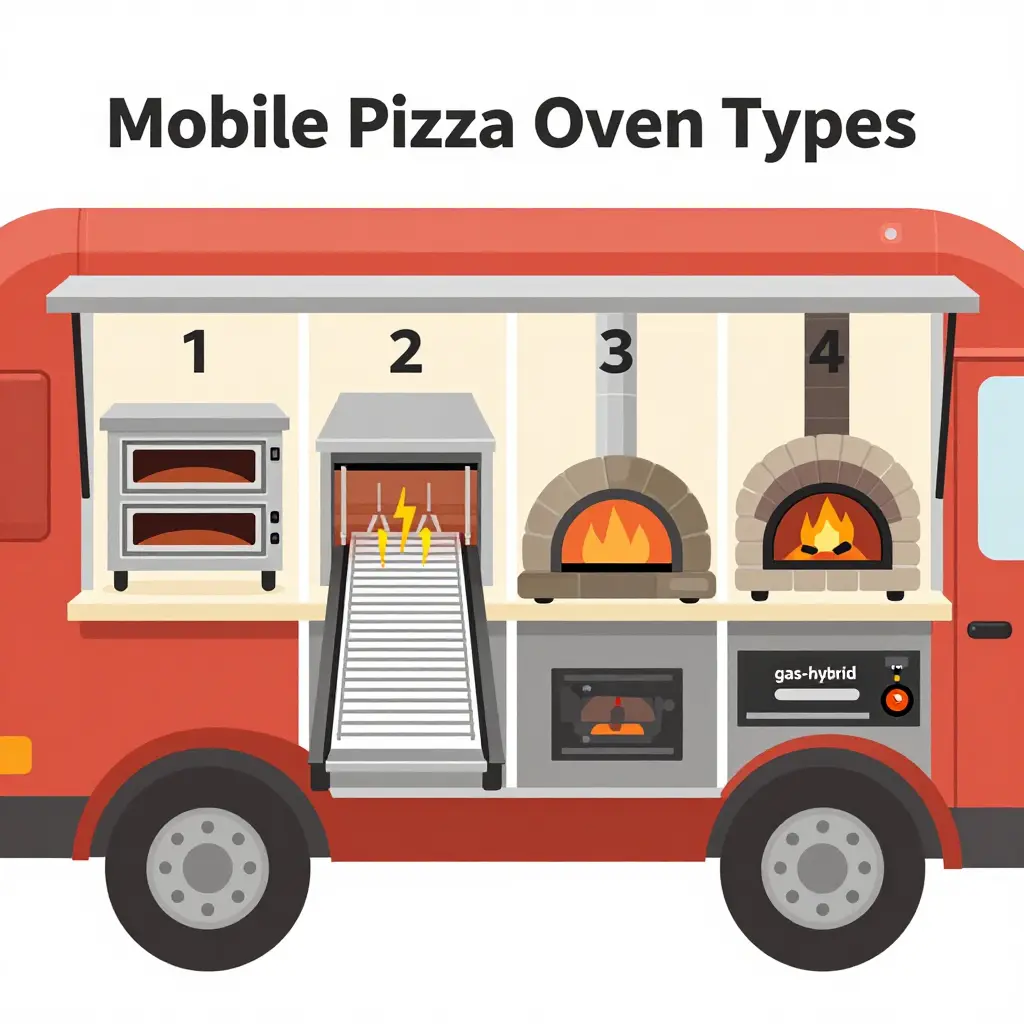
Deck ovens
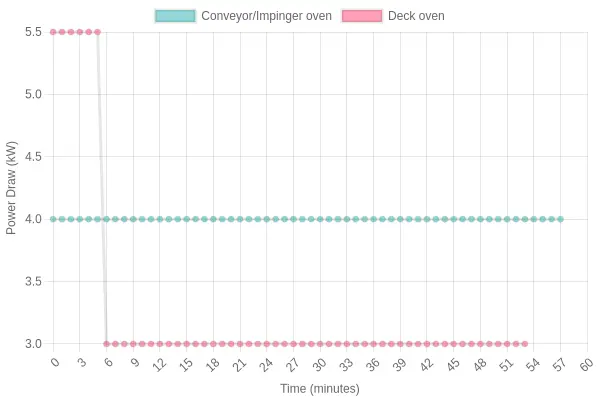
A deck oven uses thick stone or ceramic plates above and below a baking chamber, heated by resistance elements. The stones hold heat like a thermal battery, so a typical electric deck oven draws its full pizza oven wattage during warm-up, then cycles the elements on and off to hold temperature. When the elements all fire at once, the load jumps.
Conveyor (impinger) ovens
A conveyor oven moves pizzas through a tunnel on a mesh belt while fans push hot air down onto them. Its blowers and multiple element banks run almost constantly, so the oven power draw stays flat and predictable. That steadiness makes conveyor ovens easier to size against a generator.
Stone and brick ovens
Traditional stone ovens rely on a domed chamber and retained heat. Electric versions use embedded heating coils; wood-fired versions burn fuel. The electric type draws a large load early to charge the masonry, then settles into a lower maintenance draw.
Gas and hybrid alternatives
Gas ovens burn propane or natural gas for the bake, which removes most of the electrical load. A hybrid pairs a gas burner with an electric element or convection fan, so it still needs power, but far less than a fully electric pizza oven.
Why the load behaves differently
A conveyor oven holds a steady, continuous load because its fans and elements rarely shut off completely. A deck oven pulls its full rated wattage while the cold stones soak up heat, and its thermostat then switches the elements in bursts; when they fire together, the load climbs. That surge is often what makes a generator struggle, even when the running load looks modest.
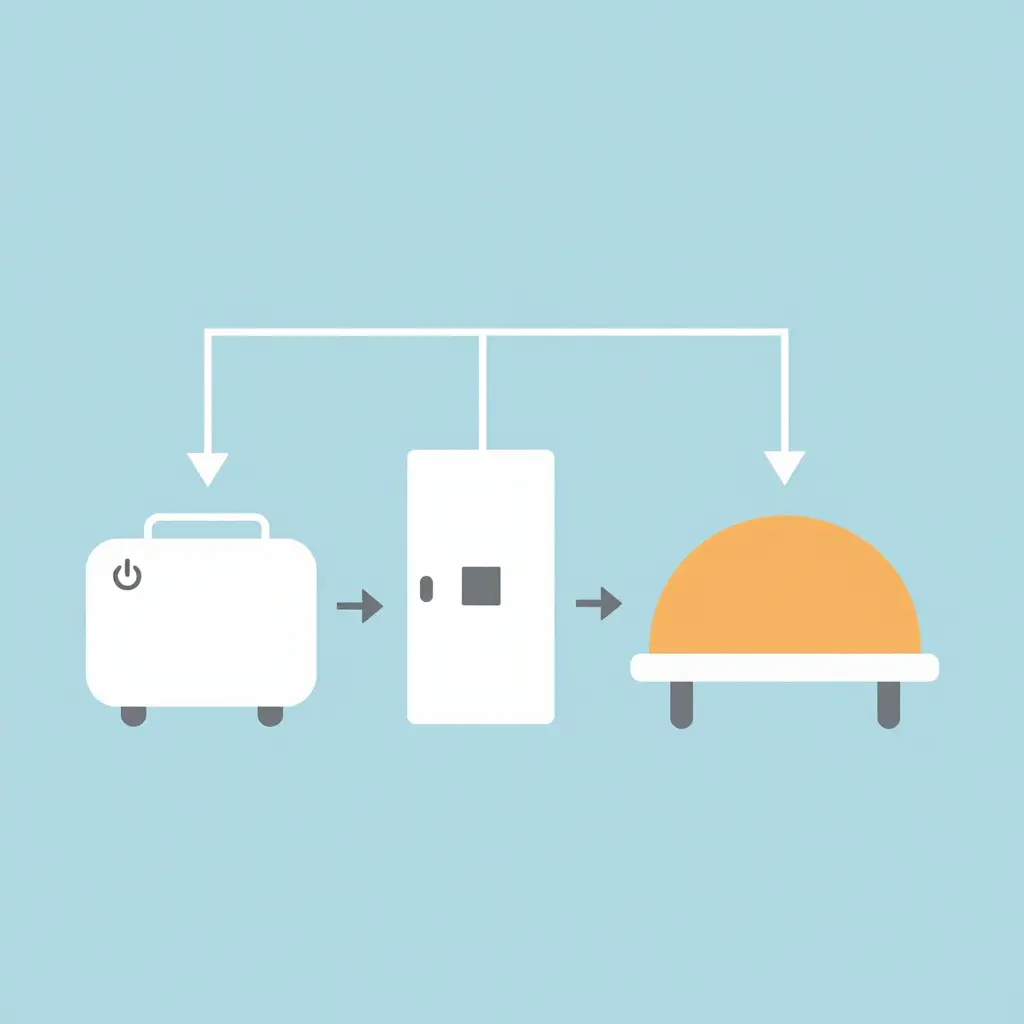
The diagram traces the path power takes inside the truck. Electricity leaves the generator, passes through the distribution panel where a breaker protects the circuit, and reaches the oven. Keep that chain short and well matched and you avoid most tripped breakers and burnt-out components.
Generator Capacity Fundamentals for Your Pizza Truck
Generator capacity is the total electrical power a generator can hand your truck’s equipment at any moment. On a pizza truck, every oven, fridge, light, POS terminal, and exhaust fan has to fit inside that one number. Get it wrong and the ovens trip a breaker in the middle of dinner service.
kW vs. kVA
Two measurements describe capacity: kilowatts (kW) and kilovolt-amperes (kVA). kW is the power that actually does work, like heating an oven or spinning a motor. kVA is the total power flowing through the system, including power that sloshes back and forth without doing useful work.
Power factor links the two. It runs from 0 to 1 and shows how efficiently current turns into work. Resistive loads such as oven elements sit close to 1.0; motor-driven gear pushes it lower. A generator rated at 20 kVA running loads at a power factor of 0.8 can deliver about 16 kW of real work.
Prime Power Rating vs. Peak Rating
Manufacturers quote two numbers. The prime power rating is what a generator can deliver continuously, hour after hour, for as long as you run the truck. The peak, or surge, rating is a short burst, usually a few seconds, that helps motors and heating elements start.
That gap matters when an oven cycles on. Pizza ovens do not draw steady power: when the thermostat clicks, the elements fire and pull a quick surge above the normal running draw. A generator sized only for steady loads may stall or trip when that happens. Food truck generator sizing starts with the surge, not the average.
Rated Output vs. Real-World Output
The nameplate number is measured under ideal conditions: sea level, mild air, a fresh engine. Altitude, heat, and age cut into it. A unit listed at 20 kW on a hot summer day may only hold 17 or 18 kW reliably.
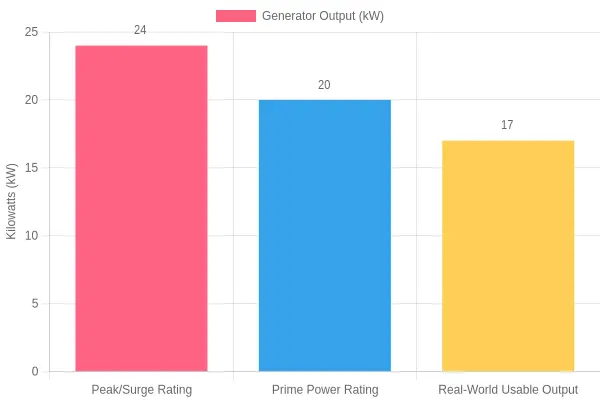
What This Means for You
- Add up the running watts of every appliance, then add the surge watts of your biggest motor or oven.
- Size for the surge, but keep the steady load inside the prime power rating.
- Leave a 20 to 30 percent buffer for hot days and older equipment.
If you are still mapping out the build, it helps to see the wider picture when building out your pizza truck before you commit to a generator.
Oven Types and Their Power Requirements at a Glance
Before you buy a generator, know what your oven will pull. Ovens carry two power numbers: the running load (what they use once hot) and the starting surge (the brief spike when a heating element or compressor kicks on). A generator has to cover the surge, not just the steady draw, or you will trip the breaker every time the oven cycles on.
The table below compares the most common pizza truck oven setups with the power they demand and a generator size that matches. Treat the recommendations as a starting point, then check them against your oven’s nameplate data.
| Oven Type | Typical Voltage | Running Load (kW) | Starting Surge (kW) | Minimum Generator Recommendation |
|---|---|---|---|---|
| Small deck oven (single deck, 16 in) | 240V single-phase | 3.5 kW | 5.0 kW | 6-7 kW |
| Large deck oven (double deck, 18-20 in) | 240V single-phase / 208V 3-phase | 7.5-9.0 kW | 12.0 kW | 12-14 kW |
| Single conveyor oven | 208-240V single-phase | 5.0-6.0 kW | 8.0 kW | 9-10 kW |
| Double conveyor oven | 208-240V three-phase | 10.0-12.0 kW | 16.0 kW | 16-18 kW |
| Gas-assisted hybrid oven | 120V single-phase | 0.8-1.2 kW | 2.0 kW | 3-4 kW |
How to Read This Table
- Voltage tells you whether you need a single-phase or three-phase generator. Most food-truck ovens run on 240V single-phase, but larger conveyor ovens often want 208V three-phase, which changes your generator options.
- Running Load is the steady-state draw. Add the oven, refrigerator, lights, and POS to get a realistic total.
- Starting Surge is the momentary spike when the heating elements first energize. This number usually pushes you into a bigger generator.
- Minimum Generator Recommendation already includes a safety margin, so the oven can fire up without bogging the generator down. Headroom costs less than a mid-service shutdown.
A Quick Reality Check
A gas-assisted hybrid oven often runs on a much smaller generator, because gas does the heavy lifting and you only power the controls, ignition, and a small fan. Pure electric decks and conveyors are power-hungry by comparison, which pushes them toward the higher end of the range. When in doubt, size up rather than down, and check the surge rating on the generator’s data sheet, not just its running watts.
Calculating Your Pizza Truck Electrical Load
Before you pick a generator, know what your kitchen actually draws. The process is inventory, measure, total, pad. Work through these steps.
- List every appliance. Write down each load on the truck: deck oven, dough mixer, refrigerators, air conditioner, lights, POS system, exhaust fan, warming lamps, and any coffee gear.
- Note running wattage. Record the continuous watts each appliance uses in normal operation. The oven power draw is usually the largest single number on the list.
- Note starting surge. Motors and compressors briefly pull far more at startup. A mixer or fridge can spike two to three times its running watts for a second or two.
- Total the continuous load. Add all the running wattages. That baseline is what the generator must supply hour after hour.
- Add a safety margin. Multiply the total by 1.25 to cover heat, aging equipment, and future additions. The buffer protects against nuisance trips.
- Account for simultaneous use. Decide which appliances run at the same time, then size for that combined load rather than the sum of everything at once.
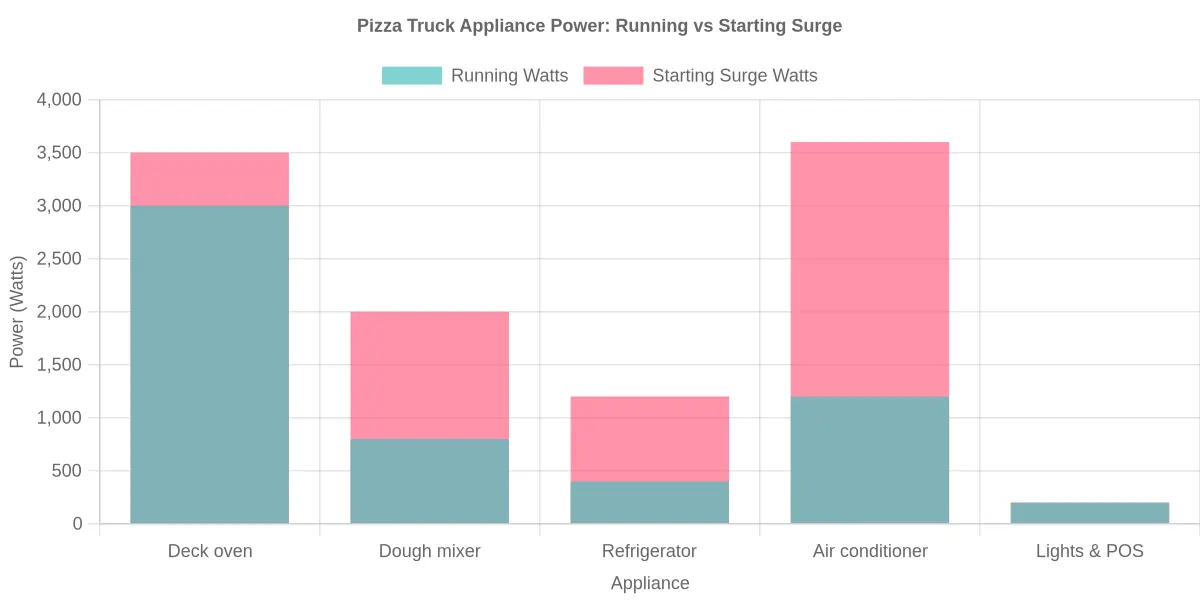
Simultaneous use means the real load depends on timing. You almost never run every device at full power at the same moment.
The oven is the clearest example. A deck oven takes 15 to 30 minutes to preheat, then cycles on and off to hold temperature. During service it fires repeatedly, but it rarely runs alone.
When the oven kicks on, the exhaust fan is moving air, the fridge is holding temp, and the lights and POS are live. That overlap is the true pizza truck electrical load you have to plan for.
When your generator capacity and oven power draw are matched to that real-world overlap, building out your kitchen gets easier and safer.
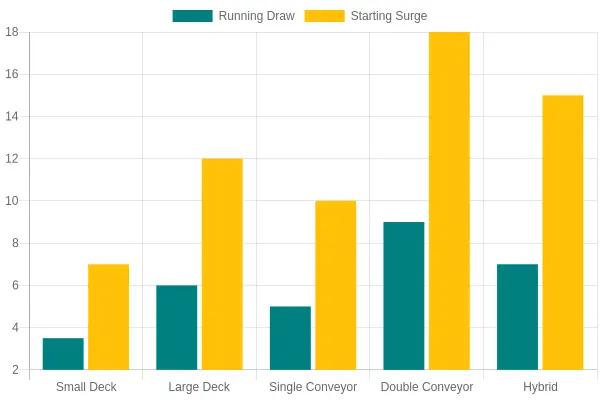
Figure: Running draw versus starting surge (kW) across five pizza oven types. The grouped bars show that surge runs about 1.5 times the running load for most ovens, and that a double conveyor oven can spike to 16 kW at startup.
Matching Oven Draw to Generator Capacity With Safety Margins
To match oven power draw to generator capacity, start with two numbers: running watts and surge load. Running watts is the steady power the oven uses once it reaches temperature. For compressors and motors, surge load is the brief inrush that can run two to three times the running figure. Resistive oven elements are different: they pull close to their rated wattage, and the load jumps mainly because all the element banks can be on at once.
Add up every load on the truck. Ovens, fridges, lights, POS terminals, and exhaust fans all pull from the same supply, so size the generator above the combined surge load, not just the running total.
The Rule of Thumb
Choose a generator whose surge rating clears your calculated surge load by at least 20 to 30 percent, and whose continuous rating stays above your total running load. That headroom absorbs voltage dips, prevents nuisance tripping, and leaves room for future equipment.
Here is how the math looks in practice.
| Oven running watts | Estimated surge load | Generator size at 25% headroom |
|---|---|---|
| 3,000 | 6,000 | 7,500 |
| 5,000 | 10,000 | 12,500 |
| 8,000 | 16,000 | 20,000 |
Soft-Start Controllers
Soft-start controllers ramp power up gradually instead of slamming the elements on. They cut the surge load, which lets a smaller generator run without tripping breakers. On high-draw ovens, they are worth the money.
Undersizing vs Oversizing
Undersizing is the costly mistake. A generator that cannot meet the surge load will trip repeatedly, dim the lights, and stress the oven’s electronics mid-service.
Oversizing costs more upfront and burns slightly more fuel at light loads, but it is far safer. A little extra capacity beats a sudden shutdown during the dinner rush.
For a full build sequence, see this guide on how to build a pizza food truck.
Avoiding Nuisance Tripping
Keep high-draw appliances on separate circuits. Start the oven before the other equipment. Match breaker ratings to each individual load. These small habits keep power flowing and the oven hot.
Where Your Truck’s Watts Actually Go
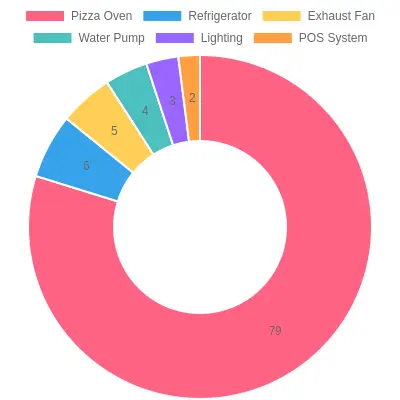
Before you size a generator, know how the load is split. The doughnut chart below breaks down total power consumption on a typical pizza truck (roughly 6,300 W peak) by appliance. The oven dominates; everything else is close to a rounding error.
| Appliance | Power Draw | Share of Total |
|---|---|---|
| Pizza Oven | 5,000 W | 79% |
| Refrigerator | 400 W | 6% |
| Exhaust Fan | 300 W | 5% |
| Water Pump | 250 W | 4% |
| Lighting | 200 W | 3% |
| POS System | 150 W | 2% |
| Total | 6,300 W | 100% |
Why This Matters for Generator Sizing
Because the oven alone pulls nearly four-fifths of the load, generator capacity is an oven problem first and a convenience problem second. A few practical notes:
- Size for surge, not just steady state. Ovens cycle and can spike momentarily, so pick a generator that covers your total plus a buffer (20-30% is a safe starting point).
- Stagger the small stuff. The fridge compressor, water pump, and exhaust fan rarely peak in the same second, but when they do, they add up.
- Keep lighting and POS on a separate circuit. They draw little but matter most; protect them so a heavy oven cycle never browns them out.
If you are mapping out the electrical plan from scratch, our guide on how to build a pizza food truck walks through the layout decisions that keep your load manageable.
Generator Runtime, Fuel, and Weight Trade-offs
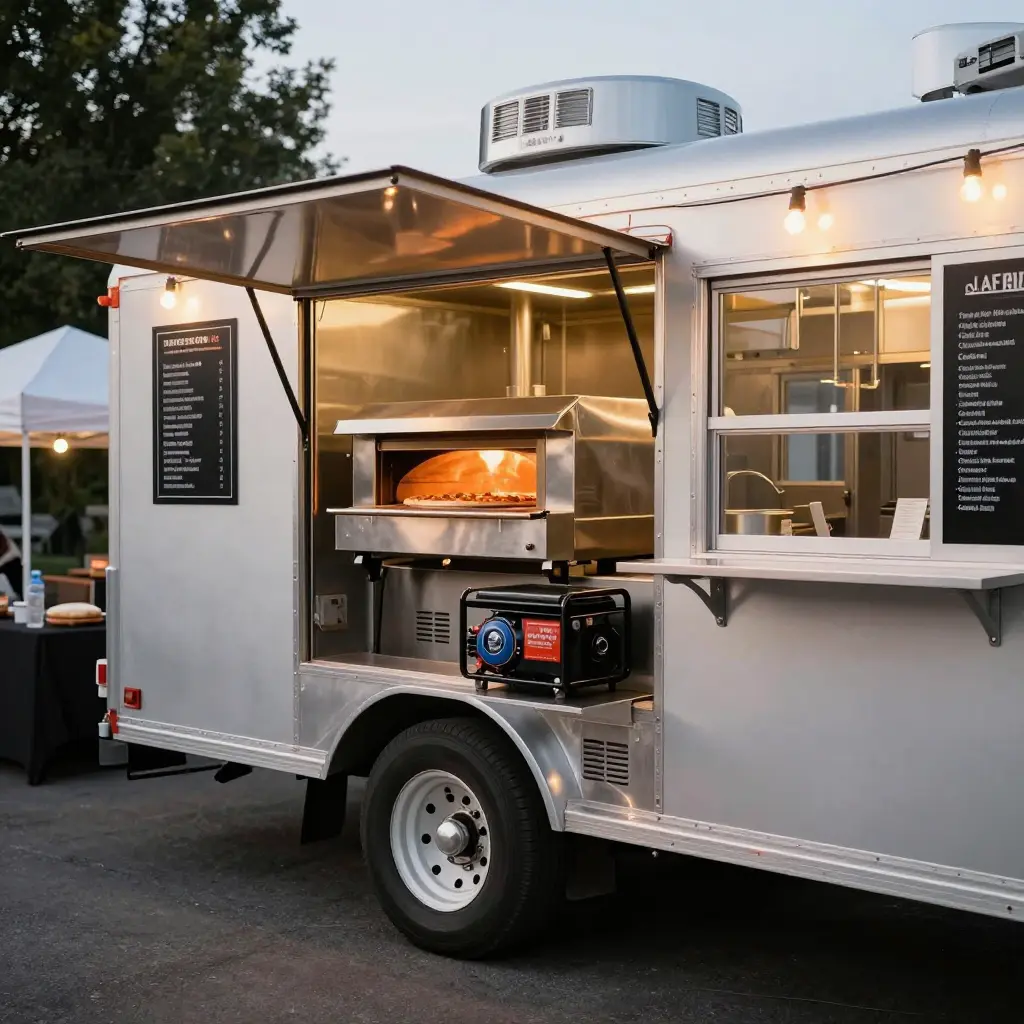
Choosing generator capacity is never a stand-alone decision. It ripples through fuel consumption, runtime, weight, and the space left for dough, cheese, and tools. For a mobile pizza business, every kilogram and every litre has to earn its place on the truck.
The instinct is to buy bigger than the ovens need. That usually backfires. An oversized unit runs at a low load, burning fuel inefficiently relative to the power it actually delivers, while adding needless weight and cost. Too small is just as bad: when ovens, lights, and refrigeration spike together, it runs flat out, overheats, and ages quickly. Matching capacity to the real draw keeps both mistakes in check.
Diesel, propane, and gasoline compared
Each fuel behaves differently in a working kitchen.
| Fuel type | Efficiency | Maintenance | Best for |
|---|---|---|---|
| Diesel | High; strong torque, low burn per kWh under steady load | Longer service intervals, engine lasts thousands of hours | High-output ovens, long shifts |
| Propane | Moderate; burns cleaner and quieter | Simple upkeep, but frequent tank swaps | Quieter sites, moderate loads |
| Gasoline | Lower; lighter and cheaper to buy | Noisier and thirstier, more frequent servicing | Small setups, backup duty |
Diesel tends to win for commercial ovens because it sips fuel under a steady load. Propane burns cleaner and quieter but carries less energy per litre, so you refuel more often. Gasoline stays cheap and light, which suits small rigs and backup generators rather than all-day production.
Why the load band matters
Generators are most fuel-efficient when they run between roughly 50 and 80 percent of rated output. In that band, fuel burn per kilowatt-hour is lowest and exhaust temperatures stay healthy.
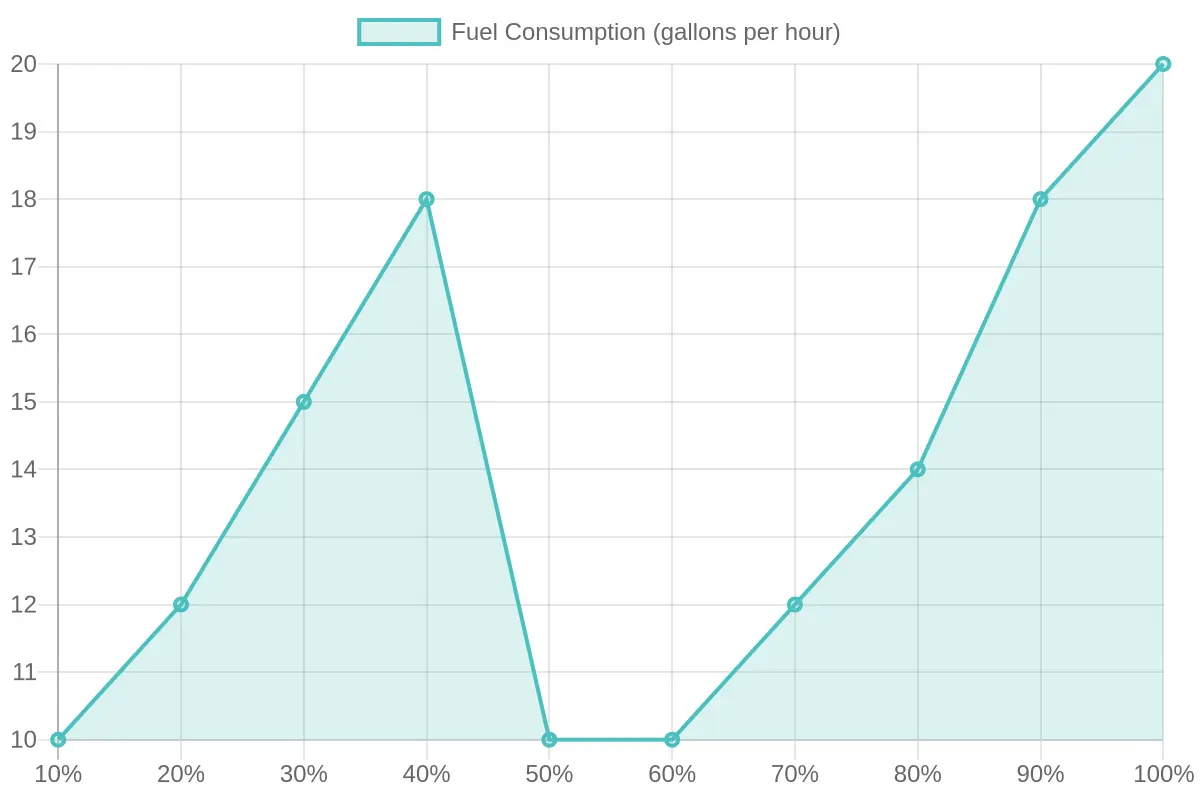
Run below the band and you waste fuel; run above it and you stress the machine. If your ovens draw about 6 kW and the total load sits near 8 kW, an 11 kW generator sits comfortably in the band. Keeping pizza truck generator fuel costs predictable shift after shift makes catering quotes easier to price.
Weight and space ripple effects
Bigger generators mean heavier frames, larger tanks, and beefier ventilation. That weight pushes you toward a larger chassis and cuts the payload left for ingredients, while fuel tanks eat cabinet space that could hold a prep surface. A right-sized generator frees both room and weight. If you are mapping the full build, our guide on how to build a pizza food truck walks through the plumbing, electrical, and layout decisions step by step.
FAQ: Generator and Oven Power Questions
Getting the power math right is one of the most common headaches when you build a pizza food truck. These are the questions owners ask most.
What size generator do I need for a conveyor pizza oven?
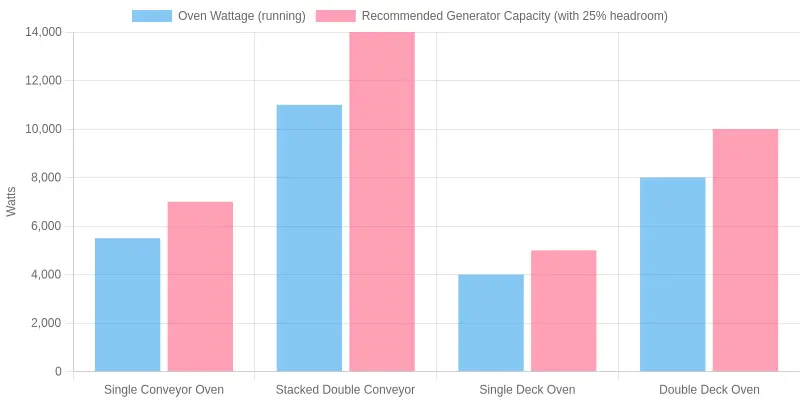
A typical single conveyor oven draws about 5,500 W while running and roughly 8,000 W at startup, so look for a unit that covers the surge with room to spare, which in practice means 9,000 to 10,000 W. Generator capacity is a whole-truck number, not an oven number, so add the fridge, lights, exhaust fan, and POS before you shop; most single-oven builds land at 10,000-12,000 W.
Can one generator run two deck ovens?
Yes, if the numbers add up. Two 4,000 W deck ovens total 8,000 W of running load, so a generator rated for roughly 12,000-14,000 W continuous can carry both, provided you stagger their start-ups. The trap is timing: if both ovens call for heat at the same instant, their combined draw can exceed what the generator is delivering even though each one alone looks fine.
What is the difference between running load and starting surge?
Running load is the steady power an appliance uses once it is up and running. Starting surge is the brief inrush of current when a motor or compressor first fires, and it can reach two to three times the running figure. Resistive loads such as oven elements have a gentler surge than compressors, but a truck full of motors still adds up. Size generator capacity around the surge, not just the running total.
Do I need a soft-start device?
Not always, but they are cheap insurance. A soft-start module ramps a compressor or motor up gradually, flattening the surge so a smaller generator can handle the load. If your pizza truck oven power draw plus refrigeration is already close to your generator’s limit, a soft-start on the fridge or AC is often the smartest fix.
How much headroom should I add?
Plan for roughly 20-30% above your calculated surge load, and check that the continuous rating still covers your running total. That cushion handles aging equipment, hot summer days, and the day you add a second oven or a bigger fridge. If you expect to grow, lean toward 30%.
What happens if my generator is too small?
An undersized generator runs at its limit constantly, which means frequent breaker trips, voltage dips that stress electronics, faster wear, and a maddening slowdown on your busiest nights. In the worst case, a sagging supply can damage oven control boards or a compressor. Matching pizza oven wattage to generator capacity up front is far cheaper than replacing equipment mid-service.
| Oven type | Running load | Suggested generator (surge rating, ~25% headroom) |
|---|---|---|
| Single conveyor | 5,500 W | 9,000-10,000 W |
| Stacked double conveyor | 11,000 W | 16,000-18,000 W |
| Single deck | 4,000 W | 6,000-7,000 W |
| Double deck | 8,000 W | 12,000-14,000 W |
Matching Your Oven to Your Generator: The Takeaway
Matching a pizza truck’s oven power draw to the right generator capacity is the foundation of a dependable mobile operation. The relationship is simple: the oven’s electrical demand has to stay within what the generator can supply, both at steady running load and during the brief startup surge.
Four steps do the work. Identify your oven type, because deck, conveyor, and gas or hybrid ovens draw power very differently. Measure both running load and surge load rather than trusting nameplate figures alone. Add a safety margin so the generator never runs at its ceiling. Then choose a prime-rated generator built for continuous duty, not a standby unit meant for occasional backup.
Get this right and you protect sensitive heating elements and controls, keep fuel consumption predictable, and support the steady service catering customers expect. As you weigh equipment against your budget, it helps to understand what a pizza food truck really costs to build so electrical decisions line up with the total investment.
Planning the electrical system before the build begins is still the most reliable way to avoid costly rewiring, undersized components, and service interruptions later.